Will a Baby Bleed to Death if the Umbilcal Cord Isn't Tied Off
Listen to this podcast (MP3 - 7 MB).
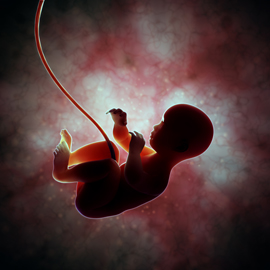
-Stock photo.
Barrett Whitener: How before long afterward a babe is born should the practitioner expect to cutting the umbilical cord? That simple question has no easy answer. Cut the cord also soon after birth might stress the baby'southward center, increase the chance for bleeding inside the brain, and increase the risk for anemia and fe deficiency. Waiting besides long may result in the infant having too many red blood cells. The backlog red cells could lead to newborn jaundice, a kind of blood poisoning resulting from the breakup of the extra red cells.
From the National Institutes of Wellness, I'm Barrett Whitener, and this is "Research Developments," a podcast from the Eunice Kennedy Shriver National Establish of Child Health and Human Development, the NICHD.
Recently, Australian scientist Stuart Hooper reviewed the major studies on the scientific discipline of when to clamp the umbilical string after nativity. Much of this extensive body of research was funded by the NICHD. To help usa sympathize these findings, nosotros have invited Dr. Tonse Raju, Main of NICHD'south Pregnancy and Perinatology Branch.
Before we go started, let's cease to consider for a minute the incredible transition an infant'south heart and lungs must make shortly after nascence. In the womb, the lungs cannot have in air, and then the infant doesn't inhale and exhale. The lungs are filled with fluid. Adults get oxygen from the lungs, just the fetus gets its oxygen from the umbilical string. The 2 chambers of the baby heart beat at roughly the same interval, to bring oxygen from the umbilical region to the tissues and ship it dorsum again. At nascency, this arrangement changes rapidly. The blood flow switches, and then that now information technology fills the lungs.
Now, here's the reason for business organisation: If you lot cut the cord earlier the babe clears its lungs, takes that first breath, and transitions its blood apportionment to the lungs, you could deprive it of blood and oxygen—and as well stress the heart.
I'yard very happy you could be with united states today, Dr. Raju.
Tonse Raju: Thank you.
Mr. Whitener: Kickoff, we practice have recommendations for when to cut the cord in infants born preterm, don't we?
Dr. Raju: Yes. The American College of Obstetricians and Gynecologists have recommended that at least thirty seconds of waiting in preterm babies would exist benign for the preterm baby'due south cardiovascular organization.
Mr. Whitener: Earlier cutting the string, then that—
Dr. Raju: Before you cut the cord, yep, a minimum of 30 seconds.
Mr. Whitener So that they can be certain to get the sufficient corporeality of oxygen to the brain.
Dr. Raju: That's correct, so they can get a sufficient amount of oxygen—blood to get into the lungs, and then oxygenated blood tin can become to the brain.
Mr. Whitener: Now, what near full-term infants? Can we say with certainty when the cord should be clamped for them?
Dr. Raju: Well, the World Health System has recommended that fifty-fifty in total-term babies, waiting up to 2 minutes after nascence would be platonic because that would enhance the amount of blood they get, and most chiefly, they finish upward getting more iron and more red cells and more iron. This will prevent them from having potentially iron deficiency anemia, which is a major problem in the residuum of the world, especially because iron is important for learning and growth, and deficiency of iron can make you lot susceptible for infections. And worldwide, almost a third to half of children in their first yr are significantly deficient in iron. And then World Health has fabricated a strong recommendation that you need to expect until at least 2 minutes or longer before you cut the cord at birth.
Mr. Whitener: And in the Us, is it truthful that physicians have more leeway as to when to cut the umbilical string?
Dr. Raju: Yes. For term babies in the The states, we don't have a specific recommendation, mainly because, on the ane mitt, peradventure the incidence of iron deficiency anemia is non that loftier, because in our food materials—in bread and other things that we eat—there is iron fortification. So we are unlikely to suffer as many babies or people with fe deficiency anemia.
As well, there is a pocket-size chance these babies, if they become more blood, then they can end up getting jaundice. That is why the ACOG decided not to brand any specific recommendation for term babies in the United states.
Mr. Whitener: At present, we mentioned the jaundice a moment agone. Are there other potential risks for cutting the umbilical cord—waiting too long?
Dr. Raju: Well, as for united states of america, we know now there are no potential risks. At that place are more than close to x,000 babies accept been studied worldwide, and there are what nosotros phone call "meta-analysis" or systematic reviews that combine these results, and from that we have learned that there'southward really no obvious negative outcome. Even the question of jaundice is probably much smaller than some people are afraid of, because, y'all know, nosotros need to exist worried nigh jaundice in every baby, not just the babies who become either earlier or delayed cord clamping. All babies could get—well-nigh lxxx percent of babies get jaundice in the starting time week of life— and we demand to brand sure that a small number of these babies don't cease upwardly having also much jaundice. So we need a planned follow-up; and if yous don't do that, at that place'southward a problem, irrespective of the time of cutting the cord.
Having said that, the other issues concerning the potential dangers of cord clamping, people have been worrying that: is in that location a trouble for the female parent, for instance? Can she end up having more bleeding after what we call "postpartum hemorrhage"? All these studies have now shown that there is no—there are no side furnishings at all for female parent'due south health and mother'due south outcome, and almost all other outcomes in the babies have been equivocal, aforementioned as babies with whom you cut the cord right abroad. Then a lot of people actually are saying that delayed cord clamping is actually the standard, and early on string clamping has no evidence, and we have been doing something without whatever good evidence why y'all had to cut the cord immediately after the babe is born.
Mr. Whitener: And then do you lot feel that this written report may accept implications for the manner this is done in the U.S.?
Dr. Raju: Absolutely, I think. It is already—I am so pleased to say that a lot of people take been changing their do, and they are already seeing some positive benefits considering they used to be worried nearly preterm babies, that if I wait long, volition I be delayed in starting any resuscitation if the baby needs resuscitation?
Just people are learning that waiting for 30 seconds or longer itself is the first step of resuscitation, because that way, the baby is already getting the blood that it needs from the placenta, so that infant's not in trouble.
Mr. Whitener: Are there circumstances where cut the umbilical cord right away is an important affair to exercise?
Dr. Raju: Yeah, I would think so. Especially, let's presume that in that location has been a significant fetal distress, and infant'south in trouble already. And there may be umbilical string tied around the neck of the baby several times. Then the obstetrician really wants to get the infant out, cutting the cord, and give the baby to the pediatrician, so that the resuscitation tin be carried out. That is i state of affairs I would imagine I tin think of when immediate clamping of the cord may exist required.
And another situation can be when at that place is a hemorrhage, even before the infant is delivered, and this can occur if at that place is an abnormal insertion of the placenta. If the placental is already very low insertion, when the uterus is—the neck is dilating, the placenta can rupture, and the mom tin bleed earlier the baby comes out. And in that location are situations, what nosotros call "abruption of the placenta"—placenta gets separated out from the uterus wall fifty-fifty before the baby comes out. All these things are emergency conditions, both for the baby and the mother, and in those situations, the obstetricians may elect to clamp the cord right away.
Mr. Whitener: So given these various circumstances that can face physicians who are delivering babies, when do you think we could expect some information to guide new mothers and practitioners on this issue? Is the NICHD currently funding further research?
Dr. Raju: Correct. I mean, first of all, I desire to underline that these complications I only listed are rare. They are non everyday occurrence, thankfully—probably about perhaps v per centum of all births may accept place. So the incidence is not that common.
Now, having said that, they are of import for u.s.a. to consider, and yep, NICHD is funding many aspects related to string clamping inquiry. So i of the other—some other manner of enhancing blood flow to the infant is after the baby is born. We phone call it "cord milking": That means an obstetrician can provide a longer segment of the umbilical string, and the pediatrician tin can untwist the umbilical cord and milk it a couple of times, and so the claret that is remaining in the umbilical string will go to the baby. And studies coming from Japan take shown that milking is as effective as delayed cord clamping, and we are really—nosotros are funding a study to encounter is that truthful, not just immediately, but also in the long-term event of preterm babies, so that study is ongoing now.
Mr. Whitener: Well, thanks very much for talking with u.s. today.
Dr. Raju: Thank you.
Mr. Whitener: I've been speaking with Dr. Tonse Raju of the NICHD.
###
Well-nigh the Eunice Kennedy Shriver National Institute of Child Health and Homo Development (NICHD): The NICHD sponsors research on development, before and after birth; maternal, child, and family unit health; reproductive biology and population issues; and medical rehabilitation. For more information, visit the Institute's website at http://world wide web.nichd.nih.gov/.
chadwickatten1992.blogspot.com
Source: https://www.nichd.nih.gov/newsroom/releases/051415-podcast-umbilical-cord

Post a Comment for "Will a Baby Bleed to Death if the Umbilcal Cord Isn't Tied Off"